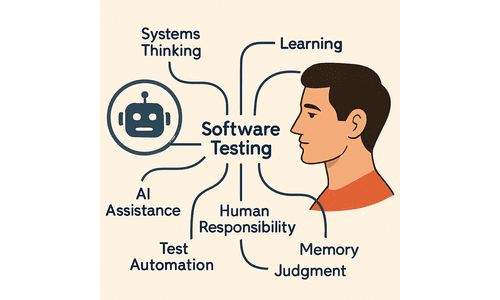
AI can process an entire codebase in seconds. It can trace dependencies, generate test cases, and even simulate user behavior with near-human fluency. Sometimes it feels like the machine is thinking faster than I can blink.
The language model may be doing something approximating human thinking, but that doesn’t mean it’s thinking for me.
I’ve been reading James Bach and Michael Bolton’s new book, Taking Testing Seriously, and it reminded me how much testing has always depended on human judgment, context, and responsibility, no matter how powerful the tools become.
Learning Through Experience
Bach and Bolton describe testing as a process of learning about a product through direct engagement—by exploring, experimenting, and experiencing it.
AI can help me explore faster, but I still have to learn. There’s no shortcut for that kind of embodied understanding. It’s the learning that implants memory in a tester’s brain, memory about how the system behaves, where it creaks, and where it hides risk.
That’s something no model can outsource.
Automation Isn’t the Whole Story
The Rapid Software Testing methodology emphasizes that testing is not defined by the artifacts we produce—like test cases or automation reports—but by the activity of investigation and evaluation.
Automation and AI can generate code, plans, and data. But the essence of testing is in the performance: observing, questioning, interpreting, and making sense of what we see.
I think about this whenever I read an AI-generated report. It often looks complete, but something in me always asks, Is that actually what we needed to know?
Responsibility Still Belongs Somewhere
According to RST, tools and automation can help us check software, but they cannot test on their own. Testing requires interpretation, judgment, and context awareness—qualities that remain distinctly human.
Even if AI executes every scenario, someone still has to take responsibility for what those results mean. Someone has to say, “I understand what this automation did. I see its limits. I’ll stand behind this call.”
It’s not about taking blame when things go wrong. It’s about stewardship. It’s about deciding who will train the AI, interpret its findings, and ensure that testing continues to serve the purpose of quality, not just completeness.
The Human Role Isn’t Diminishing; It’s Deepening
Testing today looks nothing like it did even five years ago. We’re surrounded by tools that can analyze faster, reason more broadly, and write with startling accuracy. But Taking Testing Seriously helped me realize something important.
AI expands what is possible, but it does not expand our wisdom automatically.
The work still requires the same human qualities it always did: curiosity, accountability, systems thinking, empathy. The tools change, but the craft endures.
We don’t stop being testers when the bots arrive. We become the ones who decide how they test, why they test, and what success means.
That’s what it means to take testing seriously, still.
—
Beau Brown
Testing in the real world: messy, human, worth it.
 Testing Tester
Leave a comment